
Utility and Excavation Contractor Sales and Acquisitions
Utility and site contractors sell on a multiple of adjusted EBITDA, and buyers pay more for repeat work under master service agreements that customers have renewed for years than for jobs won one bid at a time. Public contractors and private equity firms both buy in this trade, and each reads your bonding, fleet, safety record and license setup closely. GrowPCG is an M&A advisory firm that runs confidential sales for founder-led utility and site contractors and finds off-market acquisitions for buyers.

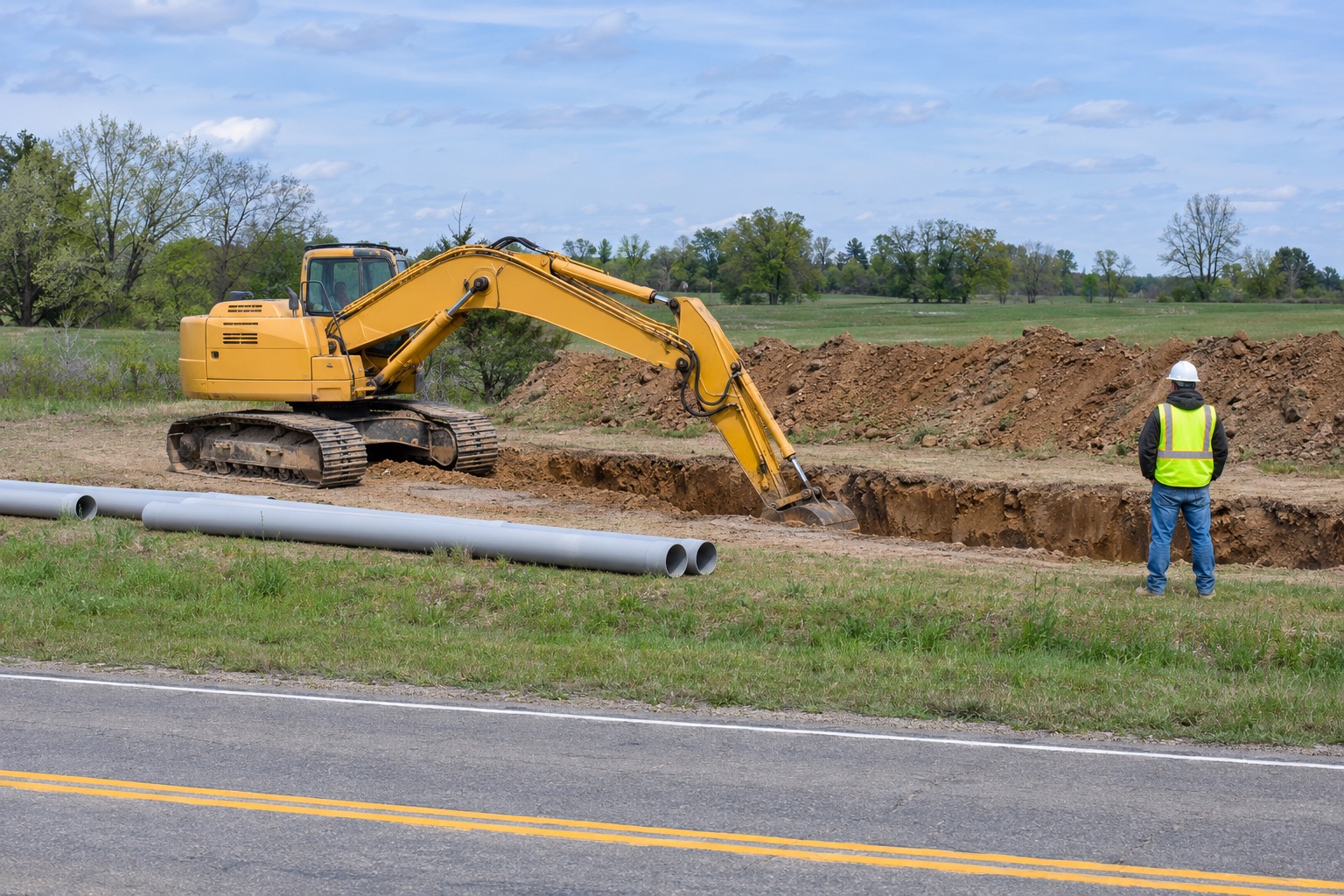
Utility and site work M&A in three numbers
Each figure is labeled by type because the types measure different things. Full sources are at the end of the page.
Selling in the next few years?
Book a confidential call →Why do buyers want utility and site contractors?
The work is necessary, not optional. Water, sewer, gas and power lines have to be maintained and replaced to keep infrastructure up to standard, and that work does not wait for a good economy. It is recession proof in a way most businesses are not: there is plenty of work to pursue whatever else the market is doing.
The pipes in the ground are old, and the spending to replace them runs for decades. In EPA's latest drinking water needs survey, about two-thirds of the 20-year need is for replacing or rehabilitating aging pipelines.
What does a buyer look at first?
The master service agreement book
Under a master service agreement, or MSA, the customer usually promises no set volume of work and can often end the agreement for convenience. So buyers value an MSA by its history, customer by customer: start date, renewals, annual spend, rate card and the terms for ending it.
How the backlog is built
Signed contract work and MSA estimates are different things. MSA backlog is usually estimated from the past year's work, and buyers give it less weight than a signed job. On bid work they read the work-in-progress schedule for over and under billings and for margin that fades between bid and finish.
The fleet
Equipment usually moves with the company, along with the contracts and the crews. Buyers want the fleet list with year, hours, condition and financing, because an old fleet sends their cash to replacements. Maintenance records for each machine help a buyer trust the list.
Bonding
Federal construction contracts above a hundred and fifty thousand dollars require performance and payment bonds. A surety underwrites you before it bonds you, and if you fail to perform, you repay what it pays out. Buyers ask for your surety, limits, claims history and open bonded jobs.
Safety record
Buyers ask for three years of OSHA logs, citations and your experience mod. OSHA requires that each employee in an excavation be protected from cave-ins by an adequate protective system, with narrow exceptions, so trench citations draw attention.
Licenses and gas qualifications
In Florida, underground utility and excavation contracting is its own licensed specialty, and a business holds the license through a qualifying agent. Buyers ask early who that person is. Gas distribution work adds operator qualification: each pipeline operator "shall have and follow a written qualification program" that ensures the people doing covered tasks are qualified, so buyers check your crews' records.
Crews
In AGC and NCCER's 2026 workforce survey, 87% of responding firms had openings for hourly craft positions. Buyers look at your foremen, operators and drivers, how long they have been with you, and whether they will stay through the sale.
How much can I sell my utility contracting business for?
Buyers price a utility or site contracting business on a multiple of adjusted EBITDA: earnings before interest, taxes, depreciation and amortization, with one-time and owner-specific costs added back. Master service agreements that customers keep renewing, and foremen who run crews without you, raise the multiple. Bid work that depends on you lowers it. The ranges below are our view, based on a data collection that includes Stanford, Pepperdine, publicly disclosed deals and the Axial platform.
- Under $500,000 of EBITDA. Most sell for 2x to 4x. Contractors this size are often owner-run: you bid the work, the general contractors call your cell and the license runs through you, so a buyer must replace you.
- $500,000 to $1 million. Most sell for 3x to 4.5x, and the best reach 5x. A foreman runs each crew and someone in the office handles billing and lien paperwork, but you still bid the work and hold the license. Repeat customers on renewing agreements move the offer toward the top of the range.
- $1 million to $2 million. Most sell for 4x to 6x. Superintendents run the crews, an estimator prices the bids, and a second licensed person could qualify the company. A buyer can step in without losing the customers.
- Over $2 million. Most sell for 4x to 6x, and larger companies with strong recurring revenue under master service agreements can draw a premium above 6x. Crews in several kinds of utility work and customers with years of renewals let a public contractor or a platform, a private equity fund's base for buying more, enter a region through a company this size. Bid-driven site and earthwork contractors tend to sell toward the low end, even at this size.
Buyers infer risk from EBITDA. A larger contractor usually leans less on its owner and has more customers, more crews and superintendents, and better systems, so it carries less risk to acquire.
Private equity is the deepest pool of buyers for a contractor with managers in place, and public contractors buy in this trade as well. The price turns on fit. A buyer that needs crews for utility work it already has, or a foothold with the utilities and cities you serve, gains more from your company than one that would have to find work for your crews. Double-digit multiples usually go to very large companies with crews in many states.
Not sure where your company lands?
Book a confidential callDo my MSAs transfer to the buyer when I sell?
A master service agreement, or MSA, is a standing contract that sets the terms and rates for work a customer assigns to you over time, one work order at a time. In a stock sale, the company that signed your MSAs stays the same, but check each agreement for change-of-control and assignment terms. In an asset sale, each MSA has to be assigned, and whether the customer must consent depends on its terms. Either way, tenure and spend history are what keep the work coming. Your attorney can tell you what each agreement allows. If you would like to see how a buyer will read your MSAs before you go to market, get in touch.
What happens to my bonding when I sell my company?
Your surety underwrote the company as it stands, so a sale means a new underwriting conversation. Buyers ask early whether the surety will keep bonding the business under them, at what limits, and what happens to open bonded jobs. Bring your surety into the process before you sign a letter of intent.
Does my experience mod follow the company?
Generally, yes. Under NCCI's rating plan, the employer must notify its insurance provider in writing within 90 days of an ownership change, and the past experience of the business generally transfers to the new owner. A credit mod helps in a sale, and a debit mod is a cost the buyer will price.
What happens to our union pension obligations if I sell?
It depends on how the deal is built. For construction-industry plans, federal law treats a withdrawal as happening when the employer stops contributing but keeps doing, or resumes within 5 years, the same type of covered work in the agreement's area. An asset sale does not by itself trigger withdrawal liability if the buyer takes on substantially the same contributions, posts a bond or escrow for 5 plan years, and the seller stays secondarily liable for that period. Your attorney should map this before you go to market.
Who is buying utility and site contractors?
Private equity
Private equity firms buy utility contractors as platforms, grow them partly by acquisition and sell them on to larger funds. They look for service agreements renewed for years and a sound fleet.
Strategic buyers
Public infrastructure contractors and utility services companies buy regional companies to enter a market with crews and customers in place. Smaller public contractors look at small companies too.
Search funds and family offices
Operators backed by a search fund buy one company to run, and family offices buy with a family's capital to hold. Both favor repeat work under master service agreements over jobs won one bid at a time.
Local and regional contractors
A contractor in a neighboring market buys for crews, equipment and the agreements you hold with utilities. It knows the work and the customers, so the deal is simple and hard to keep quiet.
What are some recent utility contractor deals?
- In March 2026, Sandbrook Capital and Blackstone-managed funds bought United Utility Services, a transmission, distribution and substation contractor that Bernhard Capital Partners built partly by acquisition.
- Energy Services of America paid $24 million for Tribute Contracting and agreed in October 2026 to buy FAMCO, a West Virginia water and sewer contractor, for a base price of $6.95 million.
- Artera Services bought K.R. Swerdfeger Construction, expanding its gas distribution services into Colorado and New Mexico.
- Quanta Services reports acquiring seven additional businesses during 2025.
Two ways to sell with GrowPCG
GrowPCG runs both sell-side and buy-side engagements. We represent owners who want to sell, and we represent buyers looking for companies to acquire.
We run your sale
This is how a sell-side process runs, from the first call through closing.
- A confidential first callNo paperwork and no obligation. We ask what you want from a sale and when.
- A readiness look and data reviewWe go through your numbers and operations the way a buyer will, and show you where the soft spots are.
- Getting ready to sellOur team guides the preparation before buyers see anything. Your CPA prepares the financials, and we tell them what buyers will need.
- Going to marketOnce we represent you, we build the materials and take them to our network of buyers. Buyers first see a profile that does not name you, and your name comes out only under an NDA.
- Running the processWe vet buyers as they come in, so your time goes to the ones that best fit your goals.
- Negotiating the dealWe help you compare offers and negotiate terms, alongside your attorney and CPA.
- Diligence and closingWe manage the buyer's requests and the calendar through closing, so the business keeps running.
Most sales in the lower middle market take 6 to 12 months from going to market to closing. Our exit readiness guide covers the preparation in detail.
A private introduction
We also represent buyers looking for companies like yours. If one of them fits what you want, we can set up a private, one-to-one conversation, with no listing and no marketing. That buyer retains us and pays our fee, so there is no cost to you. Your name goes to the buyer only under an NDA.
Buying an excavation or utility contractor?
Building a utility services platform, or adding underground, water and sewer, or site work in a new region? We find owners of excavation and utility contracting companies who have not put their businesses up for sale and would talk about one. Give us the work types, customers, markets, size and structure you want, and your limits on union status, bonding and fleet age. We reach the owner, confirm interest and send you an anonymous profile, with the company's name after you sign an NDA. Teasers from our sell-side engagements go to registered buyers as well.
Questions utility and site contractors ask us
How much can I sell my utility contracting business for?
Your adjusted EBITDA sets the base, so have it documented before a buyer asks. Contractors in the lower middle market mostly sell for 2x to 6x adjusted EBITDA, rising with size, as the ranges above show. In this trade, a fleet in good shape, a clean safety record and bonding room above your backlog move an offer toward the top of its range, and so does work that fits what the buyer already does.
Can I sell if one utility is most of my revenue?
Yes, but buyers will study that relationship. Concentration is common in this trade, and it is a real risk: when one utility is most of your revenue, one decision there can take most of it away, and a master service agreement rarely promises any volume. A long history offsets it. A customer that has renewed with you for years, kept spending through slow stretches and added work or territory has shown it will stay, so a buyer values that revenue more than work from a customer you won recently. Show the tenure, the renewals and the spend by year. Expect questions, too, about whether the relationship rests on you or on your team.
Does my equipment count in the sale price?
Usually, yes, as part of the company rather than as an extra. A buyer pays for your earnings, and the fleet is what produces them, so the iron rarely brings a separate check. Equipment debt comes out of what you receive: the buyer either pays off the loans and leases on the fleet at closing or takes them on, and the price drops by that amount either way.
I'm the license qualifier. What happens to the license when I sell?
It stays with you, and the company needs a qualifier after closing. How long it has to name one, and whether it can keep contracting in the meantime, depends on the state. Name a second licensed person, or agree to stay on as qualifier for a set period, and ask your attorney how your state handles it. If you are unsure what applies where you work, we are happy to share what buyers expect on the qualifier as you prepare.
How long does it take to sell a utility contracting business?
Plan on 6 to 12 months once buyers start looking. The delays in this trade come from open bonded jobs, MSAs that need a customer's consent to assign and, for union shops, the pension position. Work through those with your surety and your attorney before you go to market. Keep monthly results ready as well, because winter slows site work and a buyer should see a slow first quarter for what it is.
How is GrowPCG paid?
When we run your sale, we are paid a success fee at closing. On a private introduction, the buyer pays our fee. Either way, we are paid only when a deal closes.
- EPA, "EPA's 7th Drinking Water Infrastructure Needs Survey and Assessment", May 2026. Checked 2026-10-16.
- IBISWorld, "Water & Sewer Line Construction in the US: Market Size", 2026. Checked 2026-10-16.
- Quanta Services, "Form 10-K for 2025", 2026. Checked 2026-10-16.
- Energy Services of America, Form 8-K on the Tribute acquisition, December 2024. Checked 2026-10-16.
- Energy Services of America, release on the FAMCO agreement, October 2026. Checked 2026-10-16.
- FAR 28.102-1, "Performance and payment bonds and alternative payment protections for construction contracts", current rule. Checked 2026-10-16.
- OSHA, 29 CFR 1926.652, "Requirements for protective systems", current rule. Checked 2026-10-16.
- NCCI, "ABCs of Experience Rating" (PDF), 2025. Checked 2026-10-16.
- Florida Statutes, section 489.105, "Definitions", and section 489.119, "Business organizations; qualifying agents", 2026. Checked 2026-10-16.
- 49 CFR 192.805, "Qualification program" (Cornell LII), current rule. Checked 2026-10-16.
- AGC and NCCER, 2026 workforce survey release, September 2026. Checked 2026-10-16.
- Axial, "What Are Businesses Selling For? Valuation Multiples by Company Size, Sector & Buyer Type", September 2026. Checked 2026-11-14.
- 29 U.S.C. 1383, "Complete withdrawal," and 1384, "Sale of assets" (Cornell LII), current law. Checked 2026-10-16.
- Bernhard Capital Partners, "BCP Completes Sale of United Utility Services", March 2026. Checked 2026-10-16.
- Artera Services, "Artera Completes Acquisition of K.R. Swerdfeger Construction", undated release. Checked 2026-10-16.
- Axial, "Construction & Engineering M&A Trends, Valuations & Data 2026", live page read November 2026. Checked 2026-11-14.
- Stanford Graduate School of Business, article on its 2026 Search Fund Study, July 2026. Checked 2026-11-19.
- Pepperdine Graziadio Business School, Private Capital Markets Reports, 2025 and 2026, 2026. Checked 2026-11-19.
Advisor estimates are opinions published by those firms, not transaction data.
Thinking about selling?
Start with a call. Every conversation is confidential, and there is no obligation.
Looking to buy?
Join the buyer network to receive teasers from our listings and notice of new opportunities.
