
Pool Service Business Sales and Acquisitions
Pool service companies sell on a multiple of adjusted EBITDA, and buyers pay more for weekly maintenance accounts that stay than for construction and one-time jobs. A company with its own technicians and repair work on its books is worth more than its routes, and the largest pool service companies are buying independents. GrowPCG is an M&A advisory firm that runs confidential sales for founder-led pool service owners and finds off-market acquisitions for buyers.

Pool service M&A in three numbers
Each figure is labeled by type because the types measure different things. Full sources are at the end of the page.
Selling in the next few years?
Book a confidential call →Why do buyers want pool service companies?
Pools need care in good years and bad. POOLCORP, the pool supply distributor, says that keeping water chemistry safe and pool equipment in repair "creates non-discretionary demand" for chemicals, equipment and parts. In 2025, about 64% of the sales in its swimming pool business came from recurring maintenance and minor repair of existing pools.
Service has also held up better than building. In a third-quarter 2026 survey by PHTA, the Pool & Hot Tub Alliance, the service, maintenance and repair segment was the only one to report higher bottom-line profits, in the +6% to +10% range. SPS PoolCare is one of the platforms that keep buying smaller companies to build route density and recurring revenue. A platform is a company a buyer owns first in a trade and then grows by buying others.
What does a buyer look at first?
Weekly accounts that stay
Expect to show how many weekly accounts you service, how many cancel in a year and what each stop brings in. Where customers can cancel any month, the record of who stayed is the closest thing a buyer has to a contract.
Route density
Pools close together mean less drive time and more stops in a technician's day. A buyer also checks whether your rates would pay a hired technician, because a rate that works when you clean the pools yourself may not cover a wage.
Service, repairs and construction
A buyer sorts your revenue by how well it repeats. Weekly service bills every month. Repair and equipment work follows it, because the technician at the pool each week is the first to see a failing pump or heater. Renovation and new construction depend on homeowners' spending, and each job has to be won again.
Chemical pricing
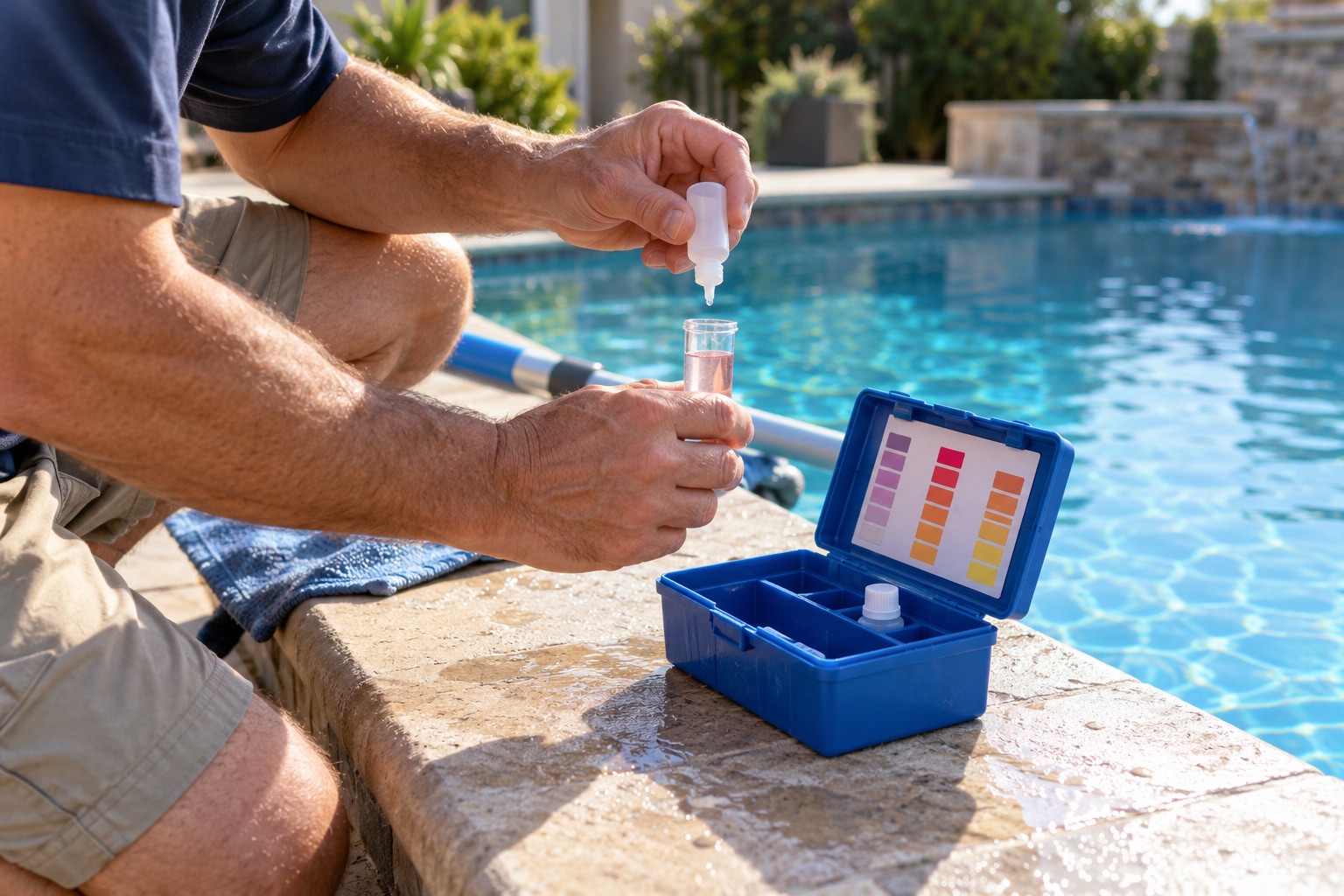
Whether chemicals sit inside a flat monthly rate or get billed on top decides who carries the price swings, you or the customer. A buyer will check which it is for each account, when you last raised rates and whether the increase held. Flat-rate accounts that have gone years without one are where margin slips first.
The license and the bench
Buyers check who holds the repair license. Skilled technicians are hard to hire and keep, so buyers also look for technicians who stay and a lead who can run the week without you.
How much can I sell my pool service business for?
Buyers value a pool service business on how many weekly accounts will stay after you leave and how much work gets done without you. They price it on a multiple of adjusted EBITDA: earnings before interest, taxes, depreciation and amortization, with one-time costs and your personal costs added back. The multiple rises when technicians, a manager and your billing system keep the company running without you on the truck. It also rises with the share of revenue from weekly service, against renovation and construction jobs won one at a time. The ranges below are our view, based on a data collection that includes Stanford, Pepperdine, publicly disclosed deals and the Axial platform.
- Under $500,000 of EBITDA. Most sell for 2x to 4x. Pool companies this size are often owner-run: you still run a route, sell the new accounts, quote the pump and heater jobs and may hold the repair license, and customers text you, not the office. A buyer has to hire for each of those jobs, and the price allows for it.
- $500,000 to $1 million. Most sell for 3x to 4.5x, and the best reach 5x. Technicians run most of the routes and someone handles billing, but you still sell the new accounts, quote the equipment jobs and may hold the repair license. A high share of weekly service, against one-time repair jobs, moves the offer toward the top of the range.
- $1 million to $2 million. Most sell for 4x to 6x. A service manager builds the routes and takes the calls, technicians run their own routes, and someone other than you holds the repair license. Customers pay by autopay, and your billing software shows every account that cancelled and why. A buyer can take over the schedule without losing accounts.
- Over $2 million. Most sell for 4x to 6x, and larger companies with a strong base of weekly service accounts can draw a premium above 6x. A company this size has dense routes across a metro, a repair and renovation crew with its own licensed staff, commercial accounts and managers who plan to stay. A national or regional platform could make it its base in your market. Companies that lean on renovation and construction jobs tend to sell toward the low end.
EBITDA tells a buyer how much risk it is taking. A larger pool company usually needs less from its owner and has more accounts, more technicians and better billing and routing systems, which makes the purchase safer.
Platforms backed by private equity are the largest group of buyers for a pool service company with a manager in place, and they are adding markets: SPS PoolCare's July 2026 purchase of Good Boy Pool Services took it into Atlanta. Fit shapes the price. To a platform entering your market, your routes are a ready-made start. To one already there, they add pools along streets its technicians already drive. A double-digit multiple, if you hear one quoted, usually belongs to a very large company with weekly accounts across many states.
Not sure where your company lands?
Book a confidential callShould I sell my pool route or my whole pool company?
For most owners we talk to, the whole company. Platforms and larger operators rarely buy a single route: they buy companies, and company sales are what GrowPCG works on. A route sale moves a list of customers. A company sale moves the business: the accounts plus the technicians, the repair work, any commercial contracts and the license. A buyer of the company prices its adjusted EBITDA, so repair and renovation profit counts along with weekly service, as long as your books and tax returns show it.
Is a summer-only pool business worth less than a year-round one?
It can be, because the year's money comes in fewer months. POOLCORP earned about 78% of its 2025 operating income in the second and third quarters, and it ties the length of its season to spring and fall weather, mainly in the northern half of the U.S. and Canada. A buyer of a northern company will ask what your technicians do between closings and openings, and how many accounts come back each spring. Storms also move repair work between years: POOLCORP said its fourth quarter of 2024 benefited from repair and replacement work after Hurricanes Helene and Milton in Florida, so expect a buyer to set a storm year apart.
SPS PoolCare works in warm states: Texas, Florida, Arizona, Nevada and Georgia. California, Florida, Texas and Arizona, the states with the most pools, made up about 53% of POOLCORP's 2025 net sales. Northern owners have buyers of their own, such as Azureon in the Northeast.
What happens to my pool license when I sell?
It depends on where you are. Licensing rules differ by state and locality, and we can help you see how yours bear on a sale. In Florida, for example, cleaning a pool and water treatment that needs no equipment work require no state license, but repairing or replacing equipment does. If the licensed qualifier leaves, the business has 60 days to employ another and may not take on contracting work until it has one, so settle who qualifies the company before closing. Commercial pools add a layer: Florida's health department may require that a public pool be serviced by a certified pool service technician. In California, motor, pump, filter and heater work falls under the D-35 pool and spa maintenance classification. Your attorney can tell you how your state handles the change of ownership. If these rules are new to you, get in touch and we can talk through how buyers handle them as you prepare.
Who is buying pool service companies?
Private equity
Private equity firms back national, regional and commercial pool service platforms that grow by buying local companies. They look for weekly accounts that stay and your own technicians.
Strategic buyers
Pool builders buy service companies because service work repeats where building does not. Pest control and other route-based companies buy pool service too, since both run on repeat visits.
Search funds and family offices
A search fund is a small group of backers behind one operator who buys a company to run. A family office buys for one wealthy family and rarely sells. Weekly service billed every month is the draw.
Individual buyers
Individuals buy smaller pool service companies to run themselves, often with a loan. They take over your role, so they ask who holds the license and whether you and your technicians will stay.
What are some recent pool service deals?
- SPS PoolCare bought Pool Troopers, a private equity backed competitor, in January 2026. The deal took it past 42,000 weekly recurring customers in 19 markets.
- Trivest Partners formed AquaVerse for local pool service brands in Florida, Georgia and Tennessee.
- Lightview Capital launched Vermana, an Orlando-based commercial pool services platform, in July 2025.
- Cabana, a tech-enabled pool service company, bought Aqua Pool Company of Concord, California, in June 2026. Aqua Pool Company serves more than 1,300 customers.
Two ways to sell with GrowPCG
GrowPCG runs both sell-side and buy-side engagements. We represent owners who want to sell, and we represent buyers looking for companies to acquire.
We run your sale
This is how a sell-side process runs, from the first call through closing.
- A confidential first callNo paperwork and no obligation. We ask what you want from a sale and when.
- A readiness look and data reviewWe go through your numbers and operations the way a buyer will, and show you where the soft spots are.
- Getting ready to sellOur team guides the preparation before buyers see anything. Your CPA prepares the financials, and we tell them what buyers will need.
- Going to marketOnce we represent you, we build the materials and take them to our network of buyers. Buyers first see a profile that does not name you, and your name comes out only under an NDA.
- Running the processWe vet buyers as they come in, so your time goes to the ones that best fit your goals.
- Negotiating the dealWe help you compare offers and negotiate terms, alongside your attorney and CPA.
- Diligence and closingWe manage the buyer's requests and the calendar through closing, so the business keeps running.
Most sales in the lower middle market take 6 to 12 months from going to market to closing. Our exit readiness guide covers the preparation in detail.
A private introduction
We also represent buyers looking for companies like yours. If one of them fits what you want, we can set up a private, one-to-one conversation, with no listing and no marketing. That buyer retains us and pays our fee, so there is no cost to you. Your name goes to the buyer only under an NDA.
Buying a pool service company?
Building a pool service platform, or adding density in a market you already serve? We find owners of pool service companies who are not shopping their businesses and would discuss a sale. Tell us your markets, the residential and commercial mix you want, size and structure, and whether you want repair and renovation work or weekly service only. We contact the owner, confirm interest and bring you a profile without the company's name, which follows once you sign an NDA. Teasers from our sell-side engagements reach registered buyers as well.
Questions pool service owners ask us
How much can I sell my pool service business for?
Your adjusted EBITDA times a multiple, and in a pool company the first adjustment is often you. If you still run a route, a buyer subtracts what a technician would cost to run it.
Will a buyer want me to keep working after I sell?
It depends on the buyer, and on what you want. A platform often wants the owner to stay. A strategic buyer, a company in your trade or one next to it, may ask only for a transition period. Any buyer is typically open to discussing your involvement based on your needs, so say early what you have in mind. A platform may pay part of your price as rollover equity, a stake in the buying company that you cash in when that company is sold. You do not have to accept rollover to sell: it is common, and it is always up for negotiation. Part can also come as an earnout, money paid later if the business hits agreed targets. Compare the cash at closing first, and have your attorney and CPA review the rest.
Does it matter to a buyer that my technicians are paid as contractors?
Yes. A buyer may have to put them on payroll, and that changes what the company costs to run. California, for example, treats a worker as an employee unless the company meets all three parts of its ABC test, one of which is that the work falls outside the usual course of the company's business. Ask your attorney and CPA how your setup holds up before a buyer asks. We can also go over what buyers usually ask about it, so your answers are ready.
Should I raise my prices before I sell?
Do it well ahead if you plan to. A higher rate that customers accept raises your earnings, and the multiple applies to them. A buyer will also read the months after the increase, and a jump in cancellations takes the gain back.
How long does it take to sell a pool service business?
Expect 6 to 12 months once buyers start looking, and time it around the season. Diligence, the buyer's review of your books and accounts, competes with your busiest weeks if it runs through June and July. Use the winter to match your account list to your billing records and tax returns, because a buyer will check each against the others.
How is GrowPCG paid?
When we run your sale, we are paid a success fee at closing. On a private introduction, the buyer pays our fee. Either way, we are paid only when a deal closes.
- POOLCORP, "Form 10-K for 2025", February 2026. Checked 2026-11-14.
- SPS PoolCare, "SPS PoolCare Celebrates Five Years, 50,000 Recurring Customers", July 2026. Checked 2026-10-16.
- Axial, "What Are Businesses Selling For? Valuation Multiples by Company Size, Sector & Buyer Type", September 2026. Checked 2026-11-14.
- Florida Statutes, section 489.105, "Definitions", and section 489.119, "Business organizations; qualifying agents", 2026. Checked 2026-10-16.
- Florida Statutes, section 514.075, "Public pool service technician; certification", 2026. Checked 2026-10-16.
- California Contractors State License Board, "D-35 Pool and Spa Maintenance", current page. Checked 2026-10-16.
- SPS PoolCare, release on the Pool Troopers acquisition, January 2026. Checked 2026-10-16.
- O2 Investment Partners, release on the Azureon platform, October 2024. Checked 2026-11-14.
- Trivest Partners, "Trivest Partners Announces Formation of AquaVerse, a Platform Supporting Local Pool Service Brands", undated. Checked 2026-11-14.
- Lightview Capital, "Lightview Capital Launches Vermana", July 2025. Checked 2026-10-16.
- Cabana, release on the Aqua Pool Company acquisition, June 2026. Checked 2026-11-14.
- California Labor and Workforce Development Agency, "ABC Test", undated. Checked 2026-11-14.
- PHTA, "Quarterly Pulse Survey," third-quarter 2026 infographic (PDF), linked from its Quarterly Pulse Survey page, results for the third quarter of 2026. Checked 2026-11-17.
- Stanford Graduate School of Business, article on its 2026 Search Fund Study, July 2026. Checked 2026-11-19.
- Pepperdine Graziadio Business School, Private Capital Markets Reports, 2025 and 2026, 2026. Checked 2026-11-19.
Advisor estimates are opinions published by those firms, not transaction data.
Thinking about selling?
Start with a call. Every conversation is confidential, and there is no obligation.
Looking to buy?
Join the buyer network to receive teasers from our listings and notice of new opportunities.
